

M. Campos
Moises Campos is a speculative fiction author whose work blends literary atmosphere with science-fiction concepts, often focusing on emotionally driven narratives shaped by uncertainty, consequence, and human behavior. His writing places strong emphasis on voice, interiority, and immersive atmosphere, balancing speculative ideas with grounded emotional realism.
Influenced by psychology, philosophy, and writers such as Philip Pullman, Ernest Hemingway, and F. Scott Fitzgerald, Campos is particularly interested in how people interpret loss, perception, and change over time. His work frequently explores isolation, repetition, and the search for meaning within unstable or shifting realities, often blending speculative concepts with emotionally grounded storytelling. He is the author of See You Soon, a speculative novel centered on time travel, persistence, and the fragility of acceptance.

See You Soon
A literary science-fiction novel about love, repetition, and the fracture of time itself. After a catastrophic anomaly alters reality, Sam becomes trapped in a recurring fracture of time tied to the death of someone he cannot let go. With each return, memory deepens, reality continues to shift, and the line between fate and choice begins to collapse.
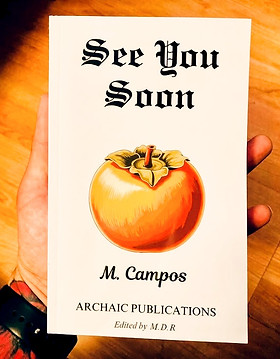
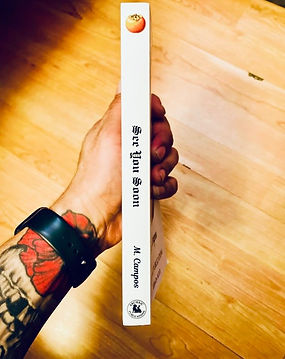


I still think there’s something strange about holding a physical copy of a story that only existed in fragments.
For years, See You Soon lived as notes, rewritten scenes, abandoned drafts, and late-night ideas I wasn’t sure would ever become anything complete. Seeing it printed made the story feel separate from me for the first time — like it had crossed into the physical world and no longer belonged only to imagination.
I wanted the cover to feel simple. Quiet. Almost disconnected from the science-fiction elements inside the novel. The persimmon became a symbol of repetition, memory, and return — something ordinary carrying emotional weight over time.
Archaic Publications was built around the idea that stories should feel preserved rather than manufactured. I’ve always been drawn to books that feel personal, atmospheric, and physically lived in. That’s the feeling I wanted this edition to carry.
— M. Campos
Author Q&A
What is See You Soon about?
See You Soon is a science-fiction novel about time travel and the consequence of refusing to let go. It mainly follows two protagonists and a supporting character caught in a repeating pattern where love, loss, and reality begin to blur.
What kind of stories do you write?
I write speculative fiction with a literary focus, often exploring time, memory, identity, and the emotional weight of human connection.
Why speculative fiction?
Speculative fiction lets me take emotional questions and place them inside impossible situations. It gives ordinary feelings a strange, heightened shape. I also find technology fascinating — especially the kind of technology that doesn’t exist yet.
How has studying psychology influenced your writing?
Studying psychology changed the way I think about perception. It made me more interested in interiority — the invisible ways people process grief, attachment, fear, and identity over time.
How would you describe your writing style?
Atmospheric, introspective, and character-driven. I like science-fiction concepts, but I care most about voice, mood, and interiority. I try to make my stories flow naturally without becoming overly dense, which was something I struggled with in some of my earlier work. It has definitely been a learning experience.
What are you currently working on?
I’m currently working on new speculative fiction projects through Archaic Publications, along with restored literary works. I occasionally return to the sequel to See You Soon, while also developing a separate project centered around extraterrestrial life that still has no official title.
What do you hope readers feel after finishing your work?
I hope readers leave with a lingering feeling rather than a simple answer. I’m interested in stories that stay emotionally present after they end — stories that continue echoing in memory. When I read a novel that stays with me long after I finish it, I can’t help but share it with others and discuss it as they progress chapter by chapter. I hope my readers experience that same excitement.